Corpus Christi, TX foundation repair
House Leveling & Foundation Piers in Corpus Christi, TX
Corpus Christi homes sit on clay that shrinks in a drought and swells after heavy rain. When part of a house moves with it, a slab home is usually fixed with piers and a pier and beam home with new supports and shims. The first step is knowing which one you have.
- Free inspection request
- No obligation to hire
- Contractors who work in Nueces County
Get a Free Foundation Inspection
Send a quick request. A local contractor will get back to you.
Slab or Pier and Beam: How to Tell What Your House Sits On
Both types are common around Corpus Christi, and the repair, the price and even the contractor you need depend on it. You can usually tell in five minutes from the yard.
- Slab: the floor sits close to yard level and the walls meet the ground
- Slab: concrete poured on the ground, with a thicker beam along the edges
- Pier and beam: a few steps up to the front door
- Pier and beam: vents or a small access door along the base of the walls
- Pier and beam: a crawl space under the floor
- Pier and beam: beams resting on blocks or piers, with shims on top
- Walk around the outside. Vents, an access door or skirting near the ground mean a crawl space. A smooth concrete edge a few inches above the dirt means a slab.
- Count the steps. A front door two or more steps above the yard often means pier and beam. A door almost at ground level points to a slab.
- Feel the floor. Wood floors that bounce or sound hollow are typical of pier and beam. A floor that feels solid everywhere, with tile laid straight on it, is usually a slab.
- Check the paperwork. An inspection report from your purchase or the original plans usually name the foundation type.
Some houses have both: an older pier and beam house with a slab addition, or a slab house with a pier and beam room added later. The joint between the two is a common place for cracks.
Signs a Slab Home Is Settling
- Doors that stick, swing on their own or no longer latch
- Diagonal cracks over doors and windows, and stair-step cracks in brick
- Gaps between the walls and the ceiling or floor at one end of the house
- Cracks in tile laid on the slab
On clay, the edges of a slab dry first in a drought, so corners and outside walls usually show it before the middle of the house. A tree close to the house or a plumbing leak under the slab can make one area worse.
Pressed Piers and Helical Piers Under a Slab
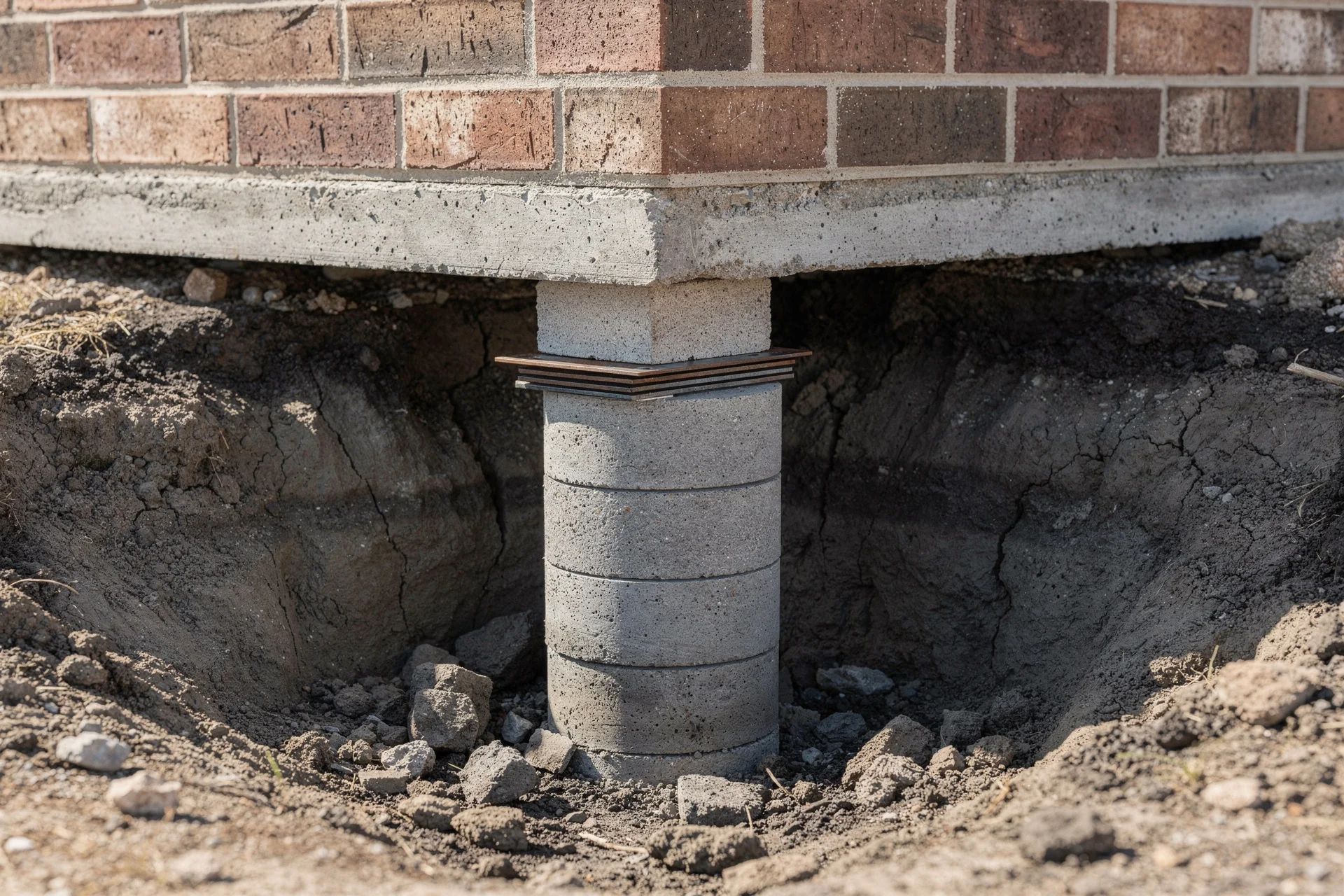
A crew digs a hole under the edge beam and installs a pier down through the active clay. The weight of that part of the house then rests on the pier instead of the clay that moves.
- The edge beam of the slab has dropped
- A hole is dug under the beam
- Precast concrete cylinders are pressed down one at a time
- The stack goes down through the active clay
- It stops at the resistance the design calls for
- Steel shims and a cap fill the gap and lift the beam
- Pressed concrete piers are short precast cylinders pushed down with a hydraulic jack against the weight of the house. They are widely used on slab homes in Texas.
- Steel push piers work the same way with steel sections, and can go deeper.
- Helical piers have screw-like plates and are turned into the ground. They suit lighter loads, porches and additions.
Inside Corpus Christi city limits, foundation repairs need a permit with an engineered, sealed foundation plan. Ask the contractor who prepares the plan and whether you will get a pier log with the depth and reading of each pier.
Leveling a Pier and Beam Home
Pier and beam floors go out of level when blocks tip or sink, when wood shims dry and shrink, or when a beam or sill rots. The work happens in the crawl space: the crew jacks the beam, resets or replaces the supports, swaps wood shims for steel, and adds piers where the spacing is too wide.
Rotted wood has to be replaced, not just shimmed. If the crawl space stays damp, the fix will not last, which is why leveling and crawl space repair in Corpus Christi often go together.
During and After the Work
Expect digging along the affected side of a slab home, or a crew working under a pier and beam home for a day or more. Some hairline cracks in drywall may appear after a lift while others close. Many contractors ask for a plumbing test before and after lifting a slab. Typical prices are in our guide to foundation repair cost in Corpus Christi.
More Questions About House Leveling & Foundation Piers
Can a house be leveled perfectly flat?
Usually not, and a good contractor will not promise it. A house that has been out of level for years has finishes, doors and plumbing that settled with it. The goal is to bring it back within a range the engineer sets, lifting slowly so new cracks stay small.
Why do contractors ask for a plumbing test on a slab home?
Drain lines run under the slab. A leak can soften the clay and cause the settlement, and lifting a slab can stress a joint that was already weak. A test before the work, and sometimes after, tells you where you stand.
How deep do piers go in Corpus Christi clay?
It depends on the site. Pressed piers are pushed until they reach the resistance the design calls for, and helical piers are turned until they reach a set torque. Ask for a pier log showing the depth and reading of each pier when the job is done.
Is it normal for cracks to appear after leveling?
Some new hairline cracks in drywall or tile are common after a lift, and some old ones close. Large new cracks, doors that bind more than before or a plumbing leak are worth a call back to the contractor right away.
Who pulls the permit?
Inside Corpus Christi city limits, the city lists foundation repairs among the residential repairs that need a permit, with an engineered, sealed foundation plan. Portland, Robstown, Gregory, Ingleside and Aransas Pass each have their own city offices. The contractor usually arranges the permit and the engineer, but confirm it in the contract.
Keep reading
Related Services
Foundation Crack Repair
Reading cracks in slabs, brick veneer and walls, sealing the ones that only leak, and fixing the movement behind the ones that grow.
Foundation Crack Repair in Corpus ChristiCrawl Space Repair & Encapsulation
Fixing the beams, sills and supports under pier and beam homes, and keeping humid Gulf air and water out of the crawl space.
Crawl Space Repair & Encapsulation in Corpus Christi
Not sure which service you need? Start with our overview of foundation repair in Corpus Christi, compare typical prices in our guide to foundation repair cost in Corpus Christi, or contact us to request an inspection.